The shift / §01
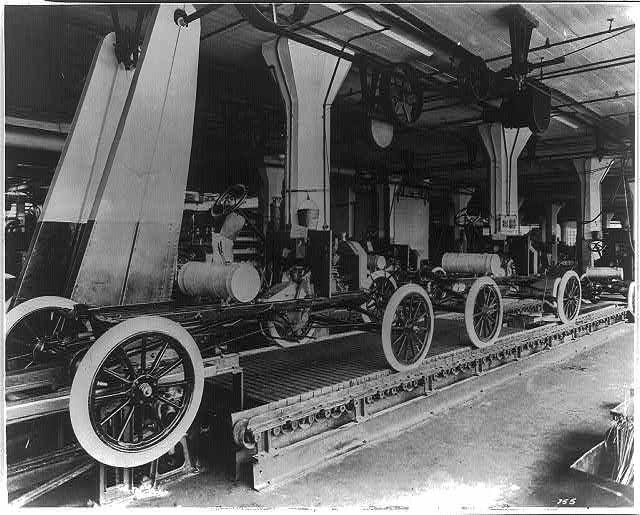
Ford's advantage was never a better car. It was a better way to make cars — specifications, interchangeable parts, specialized stations, a moving line, and gauges that rejected anything outside tolerance.
Enterprise AI now faces the same crossing. The next competitive phase isn't simply about who has the best model or the most AI talent. It's about who industrializes intelligence production first: governed meaning, reusable components, controlled flow, and deterministic validation that refuses what doesn't conform — so both people and agents can produce trusted intelligence, repeatedly, at much higher velocity.
The model is the car. The intelligence factory is the competitive advantage.
A note on where this comes from
The discipline here is what it took for us to put frontier AI into production — and the accelerator we built to do it is METIS. More on both further down.
The mapping / §02
Three objects industrialized production. The same three industrialize intelligence.
Deterministic validation / §03
A gauge isn't advice. It's a refusal.
A best practice can be ignored. A review can be inconsistent. A gauge says: this artifact doesn't satisfy the governed contract, and therefore it doesn't proceed.
That's the moment governance stops being paperwork and becomes production infrastructure — a fast pass/fail decision at the seam that lets the line run at speed because nothing out of tolerance gets through.
What the refusal did / the historical proof
Before the gate, a car was a craft object. After it, industrial output.
Hand-fitted, one at a time, by a skilled fitter. Craft shops built dozens of cars a year; Ford, stationary, reached hundreds a day and no further.
Interchangeable parts, gated. More than 1,200 chassis in a single eight-hour day (1914).
1913 — the gauge and the line arrived together. Nothing reached the line unless it passed GO / NO-GO. The gate is what let the line run without stopping to hand-fit — and that's what broke the production ceiling.
Why now / §04
Now the line runs at machine speed.
The line now includes AI — agents that research, build, test, and iterate autonomously, alongside the people who run it. Probabilistic labor fails in a particular way.
Bad code usually breaks. Bad semantics execute perfectly — and return the wrong answer at machine speed.
The objective isn't to make AI deterministic. It's to make probabilistic work governable, inspectable, and cheaply iterable inside deterministic boundaries. An agent may need five attempts to satisfy a validator — one whose tolerance a person set. If those attempts happen in seconds, and only the conforming result can proceed, iteration stops being chaos and becomes an asset.
AI without industrialization scales entropy. Industrialized AI compounds intelligence.
The divide / §05
Same talent. Different system.
Assume thirty data scientists, all brilliant. The question was never their talent — it's whether each still works as a bespoke craftsperson, or whether every project leaves behind reusable definitions, components, evidence, and learning that make the next one faster.
Where this comes from / §06
Born of necessity, at frontier scale.
The same discipline the Ford line ran on — governed meaning, reusable components, validation that refuses — is what it took for us at NeoSavant to bring two frontier products to market.
A century of movement science, operating in real time — universally, across 20+ sport domains, for the first time.
Coaching tools model one sport, one camera angle, one swing. Holding measurement across every domain meant reconciling a century of dispersed biomechanical research into one coherent, governed corpus — tractable only as a system: governed definitions, deterministic validators, and agents that iterate until they conform.
live → i3d.ai · the corpus stays behind the gauge
A live, operating model of a city — reasoning at millions of inferences while the storm moves.
Weather, radar, pressure, rain, pumps, street sensors, and grids — each with its own calibration, each able to drift, rail, or go silent exactly when the world turns most dynamic. Holding coherence across that many moving feeds is the difference between a decision and a guess. Same discipline, a different domain.
governed meaning, provenance, and deterministic verification — surviving into the operational decision
Each of these is its own story — how a research corpus becomes composable, how sensor coherence holds under an emergency — and each is a post that follows this one.
The production system / §07
So what is the factory, concretely?
Models, agents, vector stores, and MCP servers are components — substitutable suppliers behind enterprise-owned contracts. On their own they are parts on a bench. METIS — patent-pending — is the accelerator that makes them a production system.
Think of it the way engineering already thinks about its own leverage. Infrastructure-as-code industrialized operations; METIS is intelligence-as-code — an intelligence compiler. Meaning, contracts, components, evidence, and the gauges are authored as code, compiled, and projected into runtime, so the same governed definitions serve every application, agent, and analyst. Not a chatbot. Not a dashboard. The definitions, the components, and the evidence belong to the enterprise — and they get stronger with use.
What comes off the line is Trusted Executable Intelligence: a governed business capability, portable above any single runtime — not a notebook, prompt, or pipeline. Every discovery leaves behind intelligence the next one reuses. That's the flywheel — speed wins the first at-bat, quality earns the next, and repeated delivery makes the system the enterprise's preferred producer.
Do you have talented craftspeople — or an intelligence factory?
NeoSavant · governed intelligence, industrialized
Historical basis
Ford combined interchangeable parts, subdivided labor, and the movement of work to workers in the 1913 moving assembly line; The Henry Ford reports Model T production falling from roughly 12.5 to about 1.5 person-hours. Johansson formulated the precision gauge-block concept in 1896, and Ford purchased C.E. Johansson, Inc. in 1923, bringing precision measurement into mass production.
Sources
The Henry Ford — Henry Ford: Assembly Line · Highland Park Plant · Johansson Gauge Block Set, 1923
NIST — The Gage Block Handbook · Gauge Blocks: A Zombie Technology
The NeoSavant Team
Engineering
Engineers building governed generative and agentic AI, computer vision, and production AI systems.